
Visible symptom
The logo is continuous until it suddenly is not
A team adds a logo in Bootloader and the product feels much faster. Then the kernel probes the display driver and the panel flashes. Another team launches a Linux splash as early as possible; it looks correct until the compositor takes DRM master and exposes black. In both cases the splash did its job. The next owner changed the conditions under which that image was being scanned out.
The distinction matters to platform engineers and UI teams because responsibility is often split. Branding owns the bitmap, bootloader engineers own early initialization, kernel engineers own DRM, and the application team owns the final frame. No individual team owns the complete visual sequence.
A splash can remain visible across a transition, but only when the surrounding implementation deliberately preserves compatible state. The bitmap itself does not preserve a pixel clock, bridge configuration, panel power sequence, CRTC, plane assignment, framebuffer address, cache coherency, or backlight level.
A useful test: remove the logo from the reasoning.
If the same framebuffer contained a solid color, would the display link remain active and scan out the same memory while the next driver probes? If the answer is unknown, the handover is not yet defined.
Diagnostic signs
Determine whether content or hardware state disappeared
Film the panel and watch the backlight, link behavior, and pixels separately. A full backlight drop suggests a power or backlight policy transition. A monitor reporting “no signal” points toward link or mode loss. A short black frame with stable backlight may be a blank plane, a newly allocated framebuffer, or a compositor commit.
Correlate those observations with the bootloader’s display enable, kernel driver bind, first DRM atomic commit, splash exit, compositor acquisition, and application readiness:
journalctl -b -o short-monotonic
dmesg | grep -Ei 'drm|fb|panel|bridge|backlight|simpledrm|simplefb'
cat /sys/kernel/debug/dri/0/state
Debugfs requires appropriate kernel configuration, mounting, and privileges. The exact card number varies. Avoid drawing conclusions from one keyword: a driver can inherit state without logging that every register remained untouched, and it can also trigger a visible change as part of a normal successful probe.
Compare before and after state
Record resolution, refresh rate, pixel format, stride, framebuffer physical placement, bridge configuration, panel enable GPIOs, regulator state, clocks, and backlight control. The receiving stage must either inherit those values or change them without interrupting visible output. A logo encoded for one stride or format can also look corrupted even when the link remains active.
Common approaches
What each splash strategy actually guarantees
| Strategy | Useful when | Does not guarantee |
|---|---|---|
| Bootloader logo | Early branding is needed and bootloader display support exists. | Kernel state inheritance or compositor readiness. |
| Plymouth or Linux splash | The Linux graphics path is available early enough to cover userspace startup. | Continuity before Linux or after the compositor takes over. |
| simplefb / simpledrm inheritance | Firmware provides a compatible framebuffer description. | That the native driver can bind without disturbing clocks, bridges, or mode state. |
| Framebuffer copy | Preserving artwork matters more than zero-copy behavior. | No visible gap during allocation, copy, or modeset. |
| Backlight delay | Hiding internal states is acceptable. | Immediate feedback or a continuously active display. |
A robust conventional implementation is possible. It requires a documented firmware-to-kernel handoff, compatible timings and formats, reserved framebuffer memory, native-driver behavior designed for takeover, and a compositor policy that does not blank the inherited frame prematurely. That can be the best solution when upstream compatibility is the dominant constraint.
Alternative architectures
Move the guarantee to the right layer
If the requirement is “show a logo early,” a splash is the correct layer. If it is “never expose an internal transition,” the guarantee must span the complete display path. Teams can coordinate every owner, keep the bootloader state until native Linux assumes it, or retain a separate permanent owner and let Linux contribute frames.
The coordinated-owner approach has the least architectural novelty but the most cross-stage contracts. State inheritance narrows the handoff but remains platform- and driver-specific. A permanent owner makes continuity explicit, but requires heterogeneous hardware, isolation, shared memory, a Linux-side integration, and long-term ownership of those components.
Choose based on product impact and maintenance capacity. A short acceptable transition does not justify unnecessary complexity. Conversely, repeatedly tuning splash exit timing cannot satisfy a requirement that the panel never reset.
Observed on real hardware
What the boot stages look like
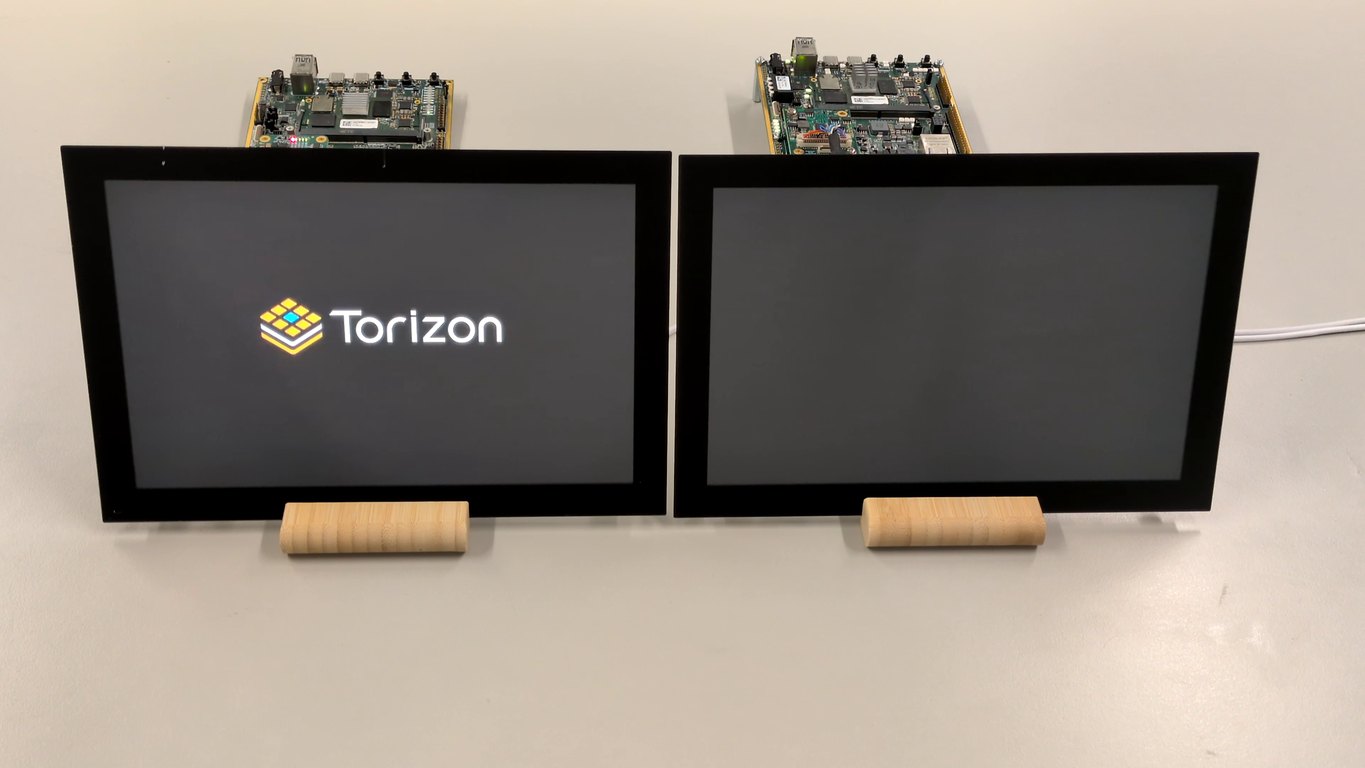
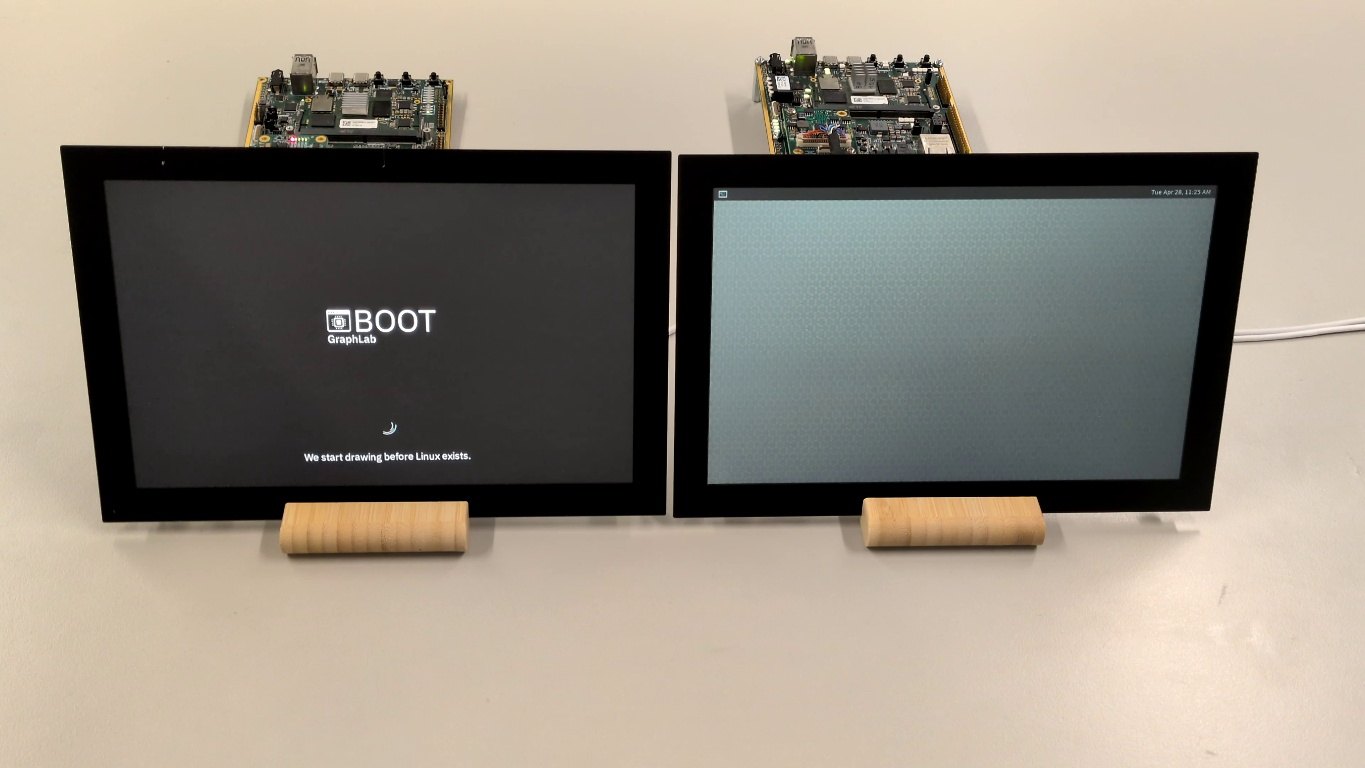
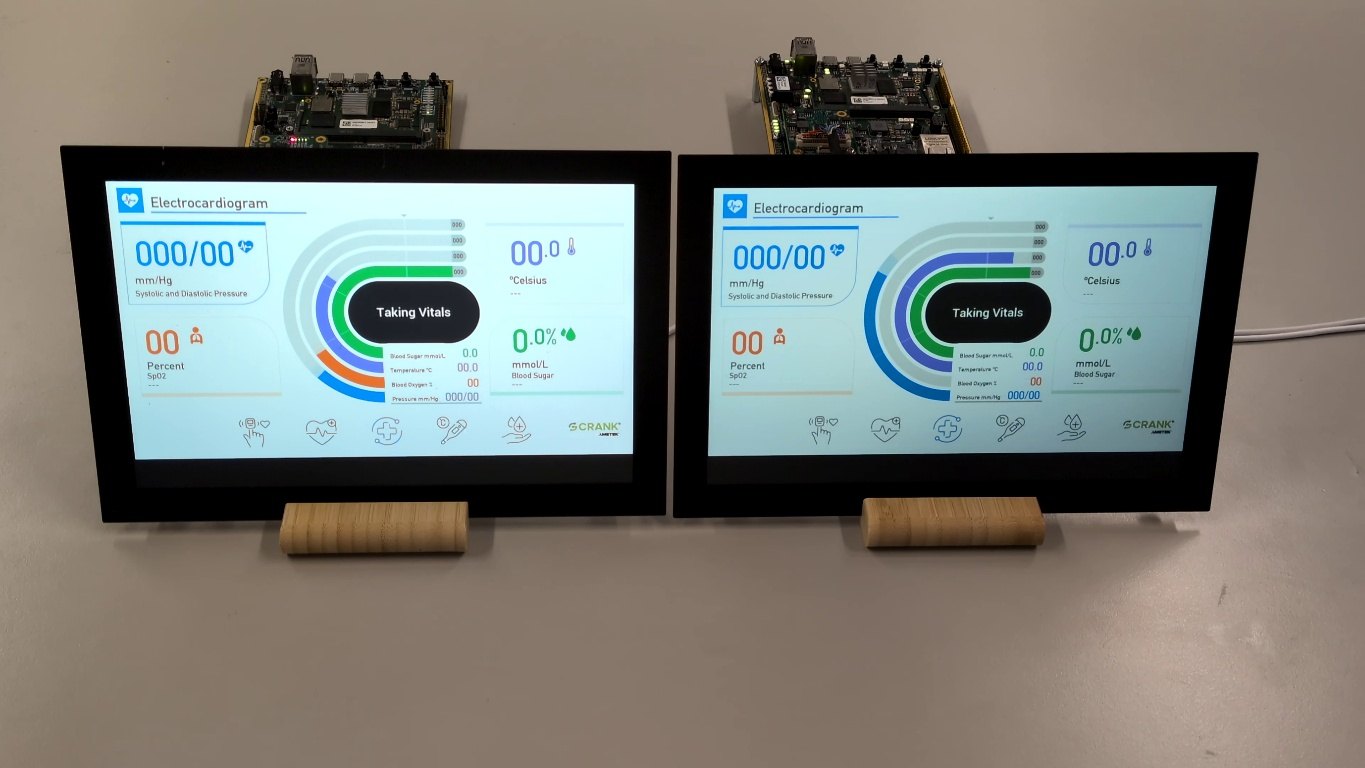
GraphLab display architecture
The early frame is part of a continuously owned pipeline
GraphLab Splash, Boot, and Pro share a display architecture that does not depend on a splash surviving a transfer of display ownership. GraphLab Core on the real-time core initializes and remains responsible for the active display path. Linux starts separately and renders into shared framebuffers. The selected Linux buffer becomes visible only when the switching policy says it is ready.
The product choice determines what appears in that continuously owned pipeline. GraphLab Splash provides approved branding. GraphLab Boot adds status, observed-milestone progress, and defined fallback behavior. GraphLab Pro combines Boot with real-time graphics library access for customer-developed early interfaces. Capabilities and integration are defined for the agreed target configuration. Display authority and controlled selection of the Linux frame are common to all three.
Scoped evidence: approximately 800 ms to first visible pixel was measured with GraphLab Boot on the validated Toradex Verdin iMX8M Plus, LVDS, and Torizon reference setup.
Linux and the application still take their normal time to become ready. The improvement is continuous, controlled visible output during that interval.
Side-by-side evidence
Standard Torizon versus GraphLab Boot
The same class of hardware is shown side by side. Compare visible output continuity, not Linux application boot duration. The GraphLab Boot side keeps a designed frame visible until the Linux-rendered application is ready. Linux application time-to-ready is not reduced.
The comparison demonstrates GraphLab Boot on the reference setup. Splash and Pro share the display-authority architecture described above; this recording does not establish their timing or validate other target configurations.
Integration reality
Where maintenance lives
A production design should name the integration surfaces and their owners. “Seamless” describes the visible result; it does not mean zero engineering or zero maintenance.
An early hook loads and starts the real-time firmware. The integration must be reviewed and forward-ported when the bootloader or vendor BSP changes.
The required device-tree additions must be documented and maintained against the supported BSP. Confirm their exact scope together with the target real-time firmware configuration.
GraphLab’s custom DRM driver must be maintained against the supported kernel and DRM interfaces, then regression-tested with the target display mode and shared-framebuffer path.
Automatic detection or an explicit application-controlled signal defines when the Linux frame is safe to show. That readiness contract belongs in the product integration.
Updates need a controlled rebase and a boot-path regression run. The work is bounded to named interfaces, but it is not eliminated.
Specify the state transition, not just the artwork
A splash is valuable content, but it becomes a continuity solution only when every later owner has an explicit inheritance and presentation contract. Treat the image, active pipeline, and readiness signal as three separate concerns. That framing reveals whether the next fix belongs in artwork timing, firmware-to-DRM handoff, compositor policy, or system architecture.
Technical references
- Linux simple framebuffer binding · Firmware-provided framebuffer description.
- Linux DRM userland interfaces · DRM master, KMS, and atomic modesetting context.
- Setting up displays with Torizon · Torizon display and overlay configuration.
- Toradex: Instant flicker-free boot · Published reference implementation.