
Here, seamless boot-to-Qt means continuous display output until a Qt application is ready. Qt’s Boot to Qt is a named embedded software stack. The display-continuity requirement also applies to other assessed Linux distributions running Qt.
Visible symptom
The display reaches Linux before the UI reaches “ready”
In an embedded Qt product, the kernel can finish display initialization well before the final interface is presentable. Weston or another Wayland compositor may expose its background. The Qt process may create a window before fonts, translations, data models, hardware services, or the first full scene are ready. A QML engine can be alive while the intended first frame is still being assembled.
Operators then see a sequence that mirrors software construction: boot logo, black, compositor color, empty window, partial controls, and finally the real dashboard. Starting Qt earlier can shorten some gaps but can also make more intermediate work visible.
The product requirement should define the first acceptable Linux frame. “Process started,” “window created,” “first buffer committed,” and “interactive application ready” are different milestones. A clean transition normally needs a frame that is visually complete and a policy for whether interactivity or live data must also be ready.
Seamless is a presentation property, not a startup benchmark.
The application may become ready at exactly the same time as before. The difference is that unfinished Linux states remain off-screen until an agreed frame can replace the early content.
Diagnostic signs
Instrument the first frame instead of guessing
Add monotonic timestamps at service start, compositor readiness, Qt process start, QML root-object creation, first render, and the moment the product declares its frame presentable. Align those markers with the boot video and system journal:
systemd-analyze critical-chain
journalctl -b -o short-monotonic -u weston -u your-qt-application
dmesg | grep -Ei 'drm|panel|bridge|framebuffer'
Unit names vary. Containerized Torizon applications also need timestamps from the container runtime and application logs. Do not treat systemd-analyze as a graphics measurement; it explains service ordering, while the camera establishes what became visible.
Define the handoff signal
An explicit readiness signal is easiest to reason about: after the Qt scene has rendered the approved initial state, the application requests the visible switch. Automatic continuous-frame detection removes an application call but needs thresholds and failure behavior. A fixed timer is simple but fragile across cold starts, updates, storage wear, network conditions, and error paths.
Also decide what happens when Qt restarts. A permanent early-display owner can show a defined maintenance or recovery frame while the compositor or application recovers. A conventional single-owner system may instead keep the last framebuffer, show the compositor background, or blank. Each is valid if specified and tested.
Common approaches
Why timing shortcuts degrade over a product lifetime
| Approach | Benefit | Failure mode |
|---|---|---|
| Start Qt as early as possible | Can reduce time to the application’s first work. | Exposes partial UI and couples reliability to service ordering. |
| Delay splash exit by N seconds | Easy to implement. | Too early on slow boots and unnecessarily late on fast boots. |
| Match splash and Qt artwork | Makes a clean handoff less noticeable. | Does not prevent a black frame, mode reset, scaling change, or color mismatch. |
| Keep compositor background branded | Covers the gap before the application window. | Adds another asset/state and does not solve the kernel-to-compositor boundary. |
| Application-controlled presentation | Uses semantic readiness. | Requires a defined API, timeout, and recovery behavior. |
The best conventional path may combine display-state inheritance, a compositor that preserves the previous frame, and an application readiness protocol. That retains normal DRM ownership and can integrate well with upstream stacks. It still needs end-to-end validation for every BSP and compositor update.
Architecture choices
Decouple rendering readiness from physical display ownership
One architecture lets the compositor own the physical output as soon as DRM is ready, then manages surfaces so the old frame remains until Qt presents. This keeps ownership inside Linux and is attractive when the DRM driver can inherit the boot state without resetting it.
Another architecture keeps a real-time core as display authority. Linux DRM provides renderable buffers without immediately becoming the component that can disturb the output path. The real-time side continues scanning early content, then selects the Linux-rendered buffer. Qt does not render through the Cortex-M and does not need to replace its normal scene graph or hardware acceleration.
The second model adds shared-memory, protection, and driver integration, but it creates a strong isolation boundary: the application can take as long as it needs without exposing construction states. The correct choice depends on whether that invariant is worth the platform-specific work.
Observed on real hardware
What the boot stages look like
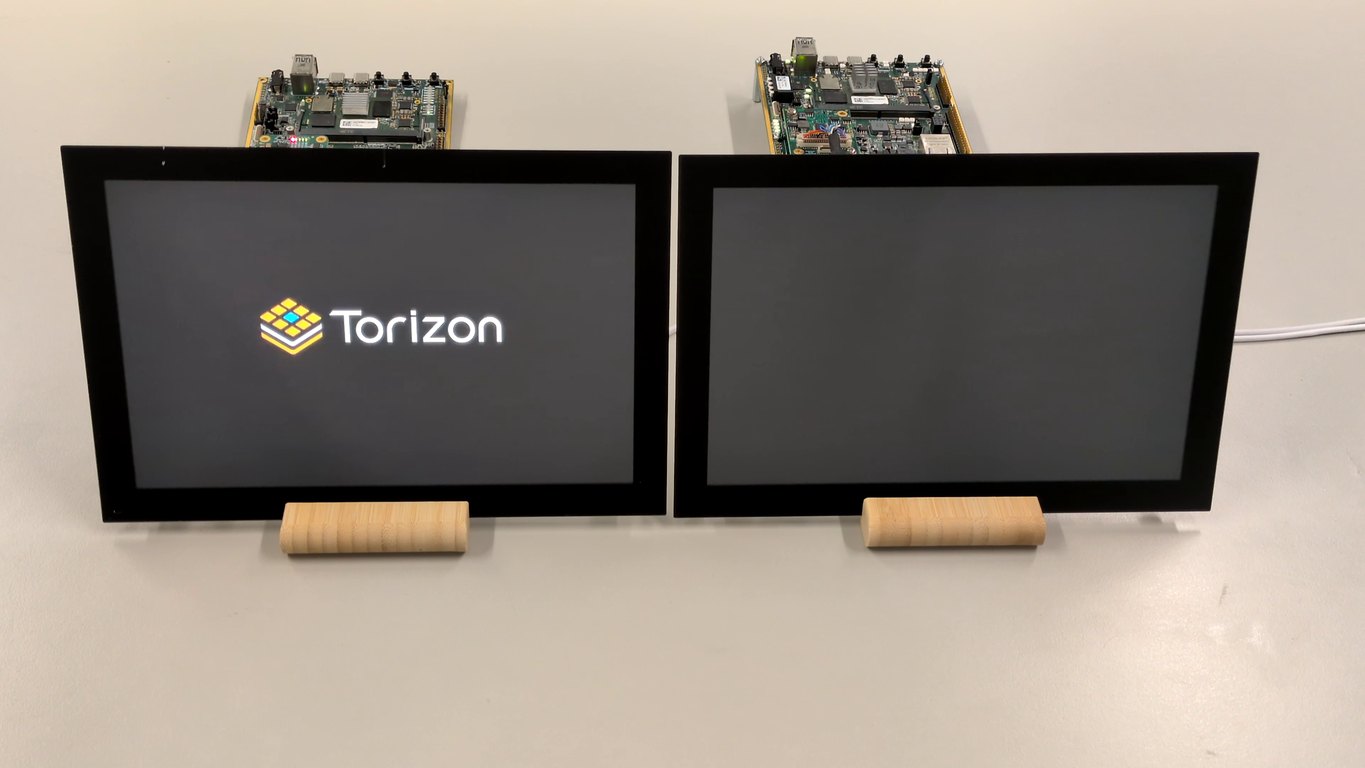
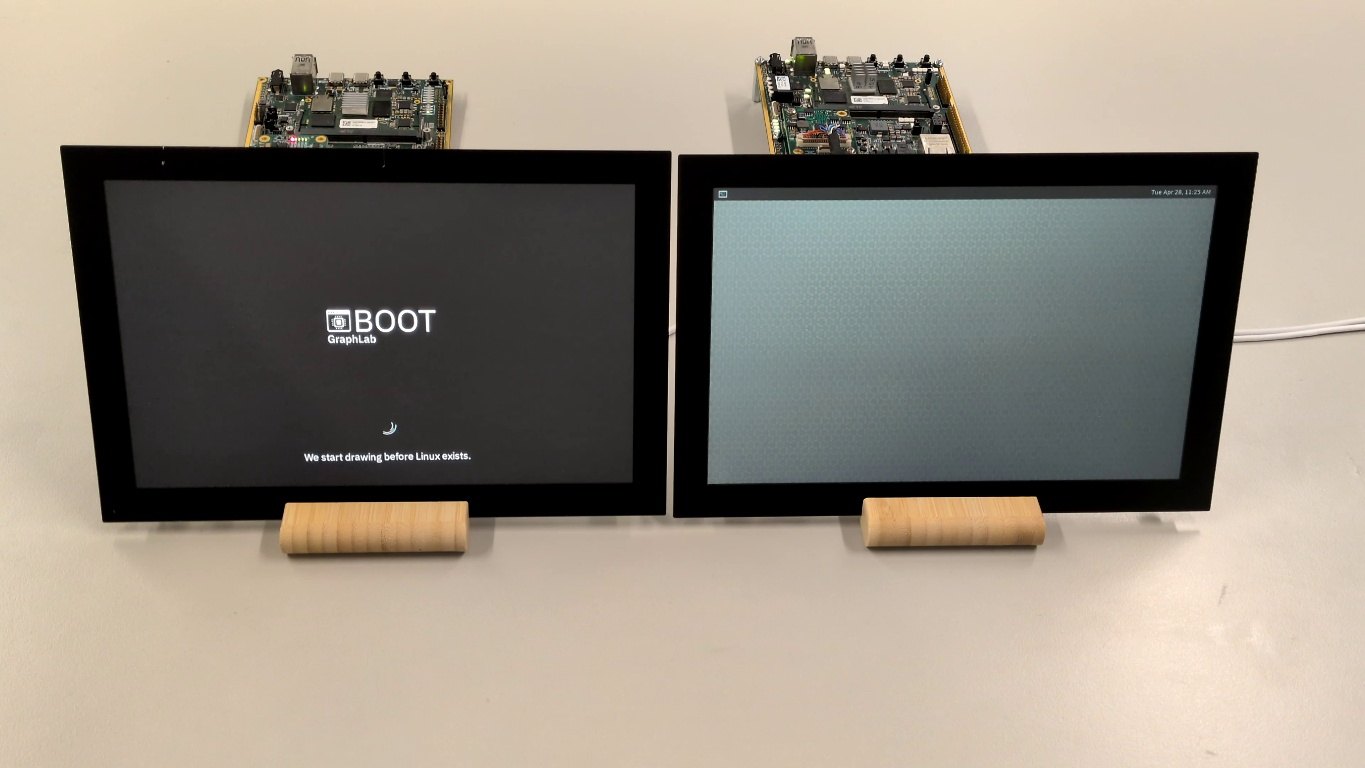
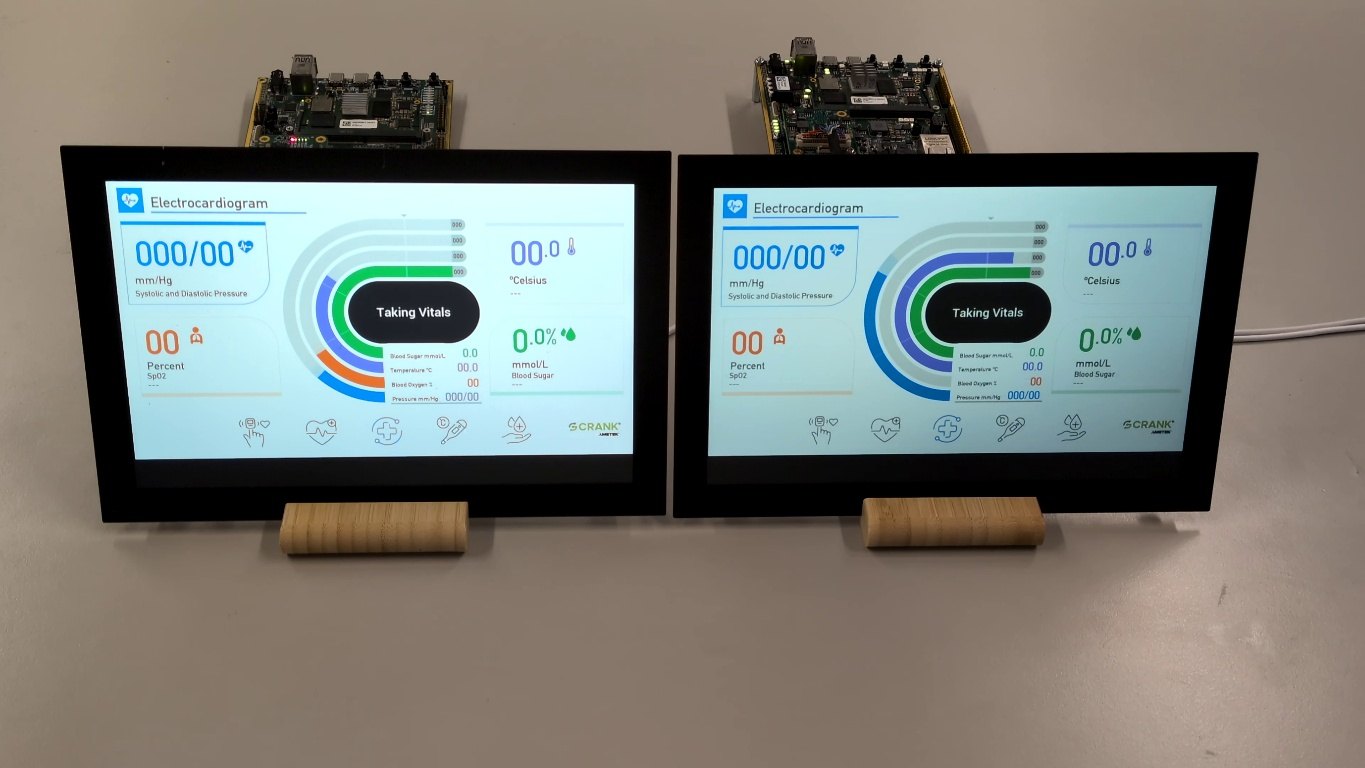
GraphLab Boot with Qt
Linux renders normally; visibility changes when Qt is ready
GraphLab Core brings up and maintains the display pipeline on the real-time core. Linux boots on the application cores, the DRM integration exposes shared framebuffers, and the compositor and Qt application start in the background. When the selected readiness condition is reached, visible output changes to the Linux-rendered buffer without reinitializing the panel.
The switch can be automatic through frame activity or explicit through the provided control path. For a product with a precise definition of “ready,” explicit application control is generally easier to validate. Recovery behavior can switch back to a defined real-time frame while Qt or its container restarts.
Proof boundary: Qt is one of the application frameworks demonstrated on the published Toradex Verdin iMX8M Plus and Torizon reference.
The approximately 800 ms figure is time to the first GraphLab Boot pixel on that validated setup. It is not time to the Qt application and GraphLab Boot does not reduce Linux application time-to-ready.
Side-by-side evidence
Standard Torizon versus GraphLab Boot
The same class of hardware is shown side by side. Compare visible output continuity, not Linux application boot duration. The GraphLab Boot side keeps a designed frame visible until the Linux-rendered application is ready. Linux application time-to-ready is not reduced.
Integration reality
Where maintenance lives
A production design should name the integration surfaces and their owners. “Seamless” describes the visible result; it does not mean zero engineering or zero maintenance.
The early hook loads GraphLab Core. Keep it small, documented, and included in the bootloader/BSP rebase checklist.
Maintain the required device-tree additions against the supported BSP and document their relationship to panel timing, routing, shared memory, and protection in the target integration.
Validate the GraphLab DRM integration against the supported kernel and the compositor/Qt hardware-acceleration path after updates.
Prefer a documented Qt-ready signal with timeout and fallback. If automatic frame detection is used, version its thresholds with the application.
Regression tests must cover cold boot, warm boot, Qt/container restart, error UI, display loss, and the supported Torizon/BSP update path.
Show the first Qt frame that the product actually approves
A seamless boot-to-Qt experience does not require pretending the application is ready earlier. It requires keeping a stable frame visible, producing Qt output off-screen, and switching only when the new frame meets a defined contract. That makes visual continuity measurable without distorting Linux boot or application performance claims.
Technical references
- Qt Wayland Compositor overview · Qt/Wayland compositor architecture.
- Working with Weston on Torizon OS · Torizon compositor context.
- Linux DRM userland interfaces · DRM/KMS presentation interfaces.
- Toradex: Instant flicker-free boot · Published Qt-compatible reference proof.